The Course Behind The Greens Isn't the One You Remember
August 20, 2026
August 20, 2026
For most of the past five years, the ninth green at the West Course sat behind a stand of overgrown grass instead of a manicured surface. If you have lived in The Greens through that stretch, you know the quiet I mean. No mower engines at dawn. No distant murmur of foursomes working their way through a round. Just the fairway going soft and wild on the other side of the fence, a version of dormancy that a golf-front community was never built to hold.
That changed on November 23, 2025, when TPC Dorado Beach debuted a rebuilt West Course. Nine months on, the mowers and cart traffic are routine again, but the thing worth understanding, if you own or spend time in The Greens, isn't simply that the course reopened. It's that the course now sitting behind your home is not a restoration of the layout you may remember from before 2020. It's a different golf course, built on the same ground, by a different generation of the same design firm, with a different playing philosophy. The land is the same. The game on it isn't.
The West Course's closure wasn't a hurricane story, at least not directly. That was the Pineapple Course's fate back in 2017, when Hurricane Maria left it damaged badly enough that it never reopened under that name. The West Course's shutdown came later, in 2020, and for a more mundane reason: real estate development on the property had begun affecting several of its holes. The corridors that golfers had played since the course reached its full 18 holes in 1966 were, in places, no longer available to play through.
What followed wasn't neglect exactly, but it wasn't maintenance either. Robert Trent Jones II, the design firm brought in to lead the rebuild, has described the course as having become overgrown during its years of inactivity. That's the texture residents actually lived with: not a construction site, but a fairway quietly reverting to scrub while the neighborhood around it stayed fully finished and occupied.
Here's where the story stops being about a reopening and starts being about a redesign. Robert Trent Jones Sr. laid out the original East and West courses in 1958, both as nine-hole layouts, expanding to full 18-hole courses by 1966. That lineage matters to the resort's identity, and it's part of why residents in golf-front communities here tend to treat the RTJ name as a kind of assurance.
But Robert Trent Jones II, run by Jones Sr.'s son and his firm, didn't simply patch the West Course back to its old routing. Bruce Charlton, the firm's president, has been candid about the intent behind the rework. His team's read on the property was that the West was meant to play differently from the East from the start, more strategic, with more options off the tee, and the rebuild leaned into that rather than away from it.
"The idea was to keep the West shorter while making it wider and more fun. We were able to do all those things and use a lot of the original corridors and reimagined them."
Read that again slowly if you're picturing the course from your own terrace. Shorter. Wider. Reimagined. That's not restoration language. That's the language of a firm choosing to build something distinct from the pre-2020 course, using the historical routing as a starting point rather than a blueprint to replicate exactly.
For comparison, the firm has talked about its earlier work on the East Course, completed roughly a decade prior, in very different terms. Charlton has called that project a return to much of Jones Sr.'s original design, describing the East now as something close to an outdoor museum piece. The West got no such treatment. It got a working revision, tuned for the way the game is actually played today rather than preserved as an artifact.
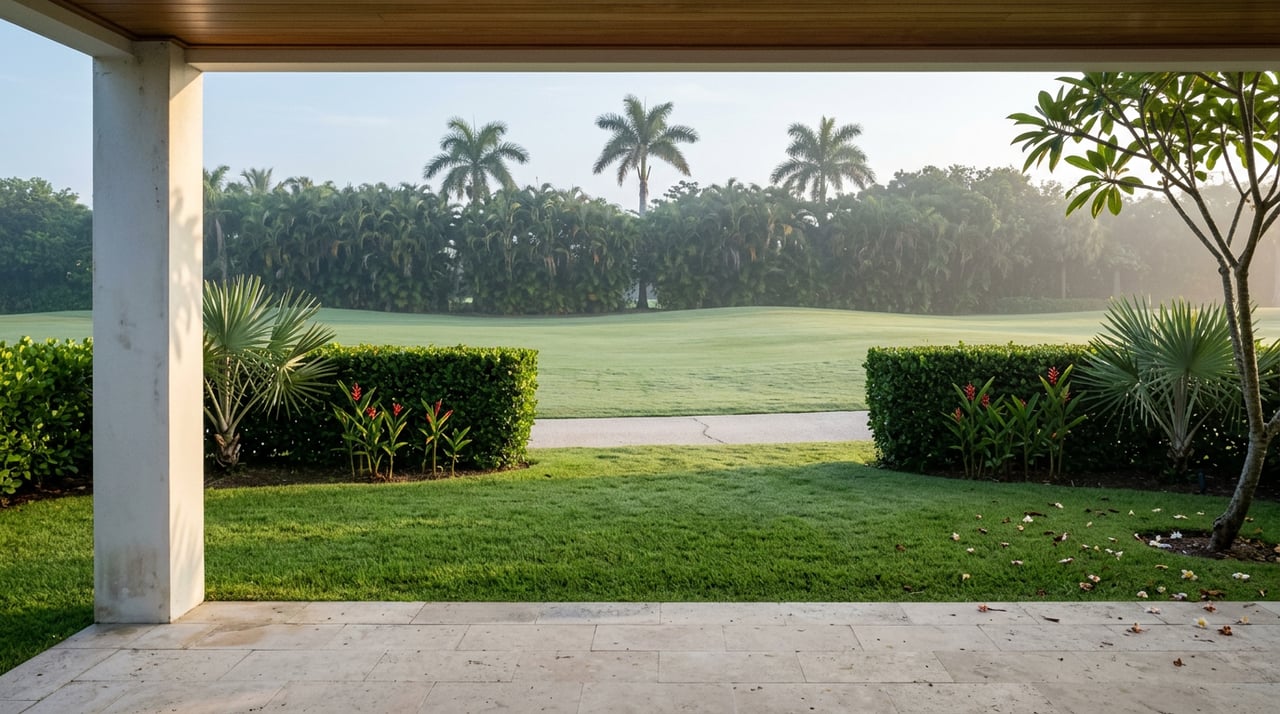
Practically, here's the distinction worth sitting with. The West Course is described by the resort itself as a parkland-style, tree-lined layout with gently undulating terrain, offering a serene inland experience rather than the exposed, ocean-adjacent character of the East. If your home in The Greens looks out toward the West Course, that's the daily backdrop you're getting back: rolling turf and tree lines, not open coastline. It's a quieter visual register than East Course frontage, and now that the course is active again, it comes with the ordinary rhythms of a working golf property. Ground crews in the early morning. Carts moving along the paths after sunrise. Golfers pausing at tee boxes within view of backyard fences.
That's a real shift from the five years just past, when the same sightline showed you idle grass and not much else. It's also worth being precise about what didn't change. The course is still routed largely through corridors that existed before, according to RTJ II's own description of the project. So the general shape of what you see from a Greens property, the tree lines, the elevation changes, the distance between your lot and the nearest hole, is likely close to what it always was. What changed sits more in the play itself: wider fairways, shorter demands off the tee, green complexes that Charlton's team says they placed with particular care given the layout's history of getting reworked around development.
Here's a detail that gets lost in the excitement of a reopening announcement: living next to a golf course and being able to walk onto it on short notice are two different privileges, and Dorado Beach draws a clear line between them. Resort guests can book tee times as far out as six months in advance. Residents, by contrast, work on a three-day booking window.
That's not a knock on the amenity. If anything, it favors the way people who actually live here tend to golf, which is less about locking in a marquee Saturday morning slot months out and more about deciding on a Tuesday that the weather looks right and the course is worth walking that week. But it's a logistics detail that's easy to miss amid coverage focused purely on the fact that the course exists again. If you're planning around the West Course's return, the three-day rule is the operative constraint, not the six-month one you might see quoted for resort guests.
One more thing worth naming honestly: the West Course doesn't yet carry the decades of tournament history and course-of-record status that the East Course has built up since its own renovation. It's arriving into a market where genuinely new, fully designed golf real estate is rare in the Caribbean, and its reputation is still being written round by round rather than inherited from the past. For residents, that's not a downside so much as a different kind of asset. You're not living next to a course whose character was fixed decades ago. You're living next to one that's still being discovered, including by the neighbors playing it for the first time this season.
If you've walked past the West Course recently and noticed it looking different than you expected, that's not a trick of memory. It is different, by design, on purpose, from a firm that chose to reimagine rather than restore. Worth knowing, if you're the one living beside it.
If you're curious what else has shifted across Dorado Beach's resort footprint this year, or you'd simply like a second set of eyes on how a change like this might affect a property you own or are watching in The Greens, I'd be glad to talk it through. Reach out to Margarita Marquez Ortiz - MMO Realty and Get Access To My Private Listings.
Stay up to date on the latest real estate trends.
I pride myself on providing personalized solutions that bring my clients closer to their dream properties and enhance their long-term wealth.